
Angular JS
What We Offer
We're here help!
Need assistance? We’re here to help with support, guidance, and resources. Reach out to us anytime.
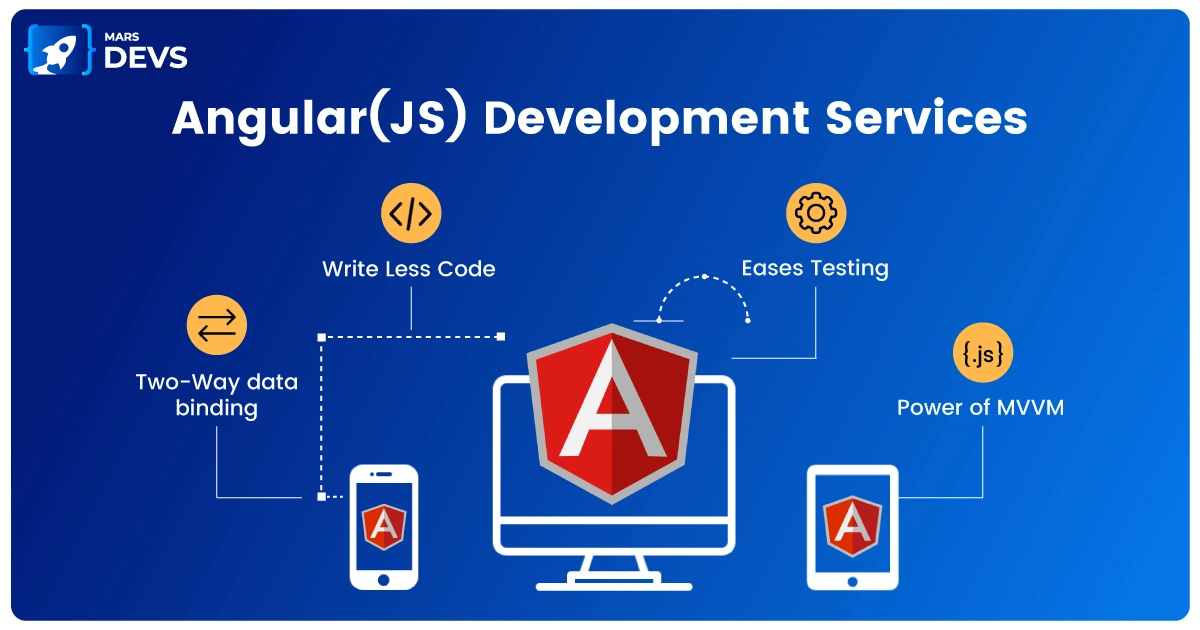
AngularJS
AngularJS is a structural JavaScript framework developed by Google for building dynamic web applications. It uses HTML as the template language and extends it with custom tags and attributes (directives).
Setting Up an AngularJS Project
You can start with AngularJS by including the library via CDN in an HTML file. It’s often paired with a modular architecture using files for controllers, services, and views.
Modules in AngularJS define containers for different parts of your application. You create a module using angular.module() which can include controllers, services, filters, and directives.
Controllers in AngularJS handle business logic and data for views. The $scope object acts as a bridge between the controller and the template, allowing data binding and function execution.
Two-Way Data Binding
One of AngularJS’s most powerful features is two-way data binding, which automatically synchronizes the data between the model and the view without needing DOM manipulation.
01
Directives in AngularJS
Directives are special attributes or elements that extend HTML functionality. Built-in directives include ng-model, ng-repeat, and ng-if, while custom directives allow reusable components.
Expressions and Filters
02
Routing with ngRoute Module
AngularJS supports single-page applications (SPA) using ngRoute. It enables navigation between different views without page reloads, using $routeProvider to define paths and templates.
Services and Dependency Injection
Services are reusable business logic objects used across controllers. AngularJS uses dependency injection (DI) to inject built-in or custom services, making code more modular and testable.